
Your vision seems fine. Reading is comfortable. Nothing hurts.
Does that necessarily mean your eyes are healthy?
For someone living with diabetes, the answer is not always yes. Changes can begin in the tiny blood vessels at the back of the eye long before they cause obvious changes in sight.
What if a routine retinal image could help identify those warning signs before the person realizes something is wrong?
That is one carefully defined role of artificial intelligence in healthcare today. But it is not a smartphone app that can diagnose every eye condition from a selfie. It involves specialized retinal imaging, a clinically evaluated AI system, and a reliable path to professional follow-up.
Here's what the evidence shows—and what it doesn't.
How can an eye problem develop without affecting vision?
The retina is the light-sensitive tissue lining the back of the eye. Its job is central to the process of seeing.
Over time, elevated blood glucose associated with diabetes can damage the retina's small blood vessels. Those vessels may leak fluid or blood, and more advanced changes can eventually threaten sight. This condition is called diabetic retinopathy.
The important detail is that early diabetic retinopathy may have no noticeable symptoms at all. The US National Eye Institute emphasizes that people with diabetes need appropriate eye examinations even if their vision seems normal. [1]
That is the reason for screening: not to wait until eyesight has already changed.
What does AI actually see?
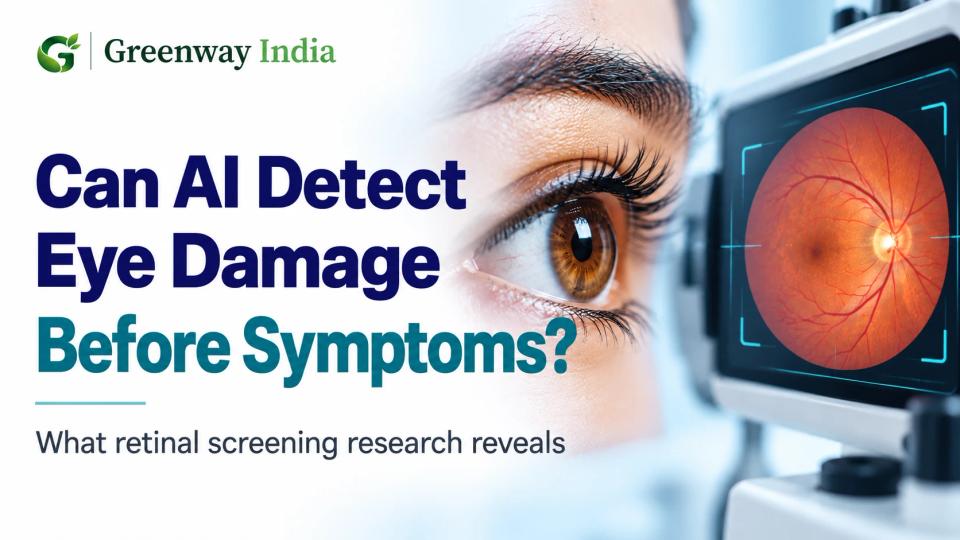
A clinician or trained operator uses a specialized fundus camera to photograph the retina at the back of the eye.
A suitably authorized AI system then analyzes the retinal photographs for patterns associated with the specific screening target for which it was developed and evaluated. Its result can guide whether the patient needs referral for a professional eye examination.
That does not turn a screening result into a complete diagnosis. Screening and comprehensive eye care serve different purposes. A positive or uncertain screening result may require further examination by an eye-care professional.
A turning point in 2018
On April 11, 2018, the US Food and Drug Administration (FDA) granted De Novo authorization for IDx-DR, an autonomous AI system for diabetic retinopathy screening. The system was later known as LumineticsCore. [2]
Its defined role was to screen eligible people with diabetes for more-than-mild diabetic retinopathy, including the relevant macular edema component of the trial's reference standard.
The word autonomous has a precise meaning here: for the particular authorized screening task, the system can deliver a result without a specialist interpreting every retinal image separately. It does not mean AI can independently provide all eye diagnoses or replace an ophthalmologist.
What did the 900-person trial find?
A pivotal study published in npj Digital Medicine in August 2018 enrolled 900 participants across 10 US primary-care sites. Of these, 892 completed the procedures, and results from 819 participants were fully analyzable under the trial's evaluation framework. [3] The reported performance of the AI system was:
Trial results at a glance
| Metric | Result | Meaning |
|---|---|---|
| Sensitivity | 87.2% | Identified people meeting the specified disease threshold |
| Specificity | 90.7% | Correctly classified people below the specified disease threshold |
| Imageability | 96.1% (819/852) | Among 852 participants with completed FPRC reference grading, 819 received a disease-level AI screening result. This measures result availability, not diagnostic accuracy. |
These numbers refer to a specific system, a specific patient population, and a specific disease-screening threshold. They are not a universal accuracy rating for medical AI, nor proof that the technology detects every eye disease.
The distinction between 900 enrolled and 819 fully analyzable also matters. Precision in reporting clinical research is part of understanding what the results actually mean. [3]
Why the 2026 guidelines matter
This is no longer just an interesting study from 2018.
The American Diabetes Association's 2026 Standards of Care recognize validated retinal photography programs using FDA-authorized AI algorithms as appropriate strategies to expand access to diabetic retinopathy screening. They also stress that patients need referral when abnormalities are found and in-person examinations when photographs cannot be interpreted reliably. [4]
The standards identify three FDA-authorized platforms for this purpose: LumineticsCore (formerly IDx-DR), EyeArt, and AEYE-DS. That is not an endorsement of every app claiming to analyze eye pictures; intended use, clinical validation, regulatory status, and the healthcare setting all matter. [4]
Crucially, retinal photography and AI screening do not replace a comprehensive dilated eye examination.
Where could this help patients?
Access is one potential advantage.
Not every primary-care practice has an ophthalmologist on site. In some communities, traveling for specialist appointments may be difficult. With the right equipment, training, clinical workflow, and referral arrangements, a primary-care clinic may be able to provide retinal screening closer to where patients receive routine diabetes care.
An abnormal result can help direct a person toward a full eye examination without requiring them to wait until their sight deteriorates.
Still, a successful technology is not the same as a successful care program. It matters whether the clinic can obtain usable images, whether patients attend follow-up appointments, whether the tool works reliably across populations, and whether treatment is available when needed.
Can the AI system be wrong?
Yes. Some cases can be missed. Some patients may be referred even though they do not meet the disease threshold. Poor-quality images can also prevent a useful screening result.
An algorithm authorized for diabetic retinopathy screening should not be presented as a reliable test for every form of glaucoma, cataract, retinal disease, or unrelated systemic illness. Each use requires its own evidence and appropriate authorization.
And there are situations in which screening is not the right next step. Sudden vision loss, a sudden shower of new floaters, flashes of light, or a curtain-like shadow over vision require urgent medical assessment, rather than waiting for a routine AI test. [5]
What should someone with diabetes do now?
The most important step is getting eye care at the recommended time, regardless of whether an AI system is available locally.
The ADA's 2026 guidance recommends a comprehensive dilated eye examination for people with type 2 diabetes at diagnosis, and an initial comprehensive examination for adults with type 1 diabetes within five years after its onset. Subsequent follow-up depends on examination findings and individual risk factors. [4]
Managing blood glucose, blood pressure, and cholesterol is also an important part of protecting eye health. [1]
The real promise of medical AI
The achievement is not that a computer can glance at someone's eye and uncover every medical secret.
It is more practical—and potentially more meaningful: a person with diabetes who feels their vision is normal may gain access to an appropriate retinal screening test and timely referral before problems become obvious.
Turning that possibility into better care still depends on trustworthy evidence, qualified professionals, responsible implementation, and follow-up.
Research sources / References
- US National Eye Institute (NEI) — Diabetic Retinopathy: https://www.nei.nih.gov/eye-health-information/eye-conditions-and-diseases/diabetic-retinopathy
- US FDA, De Novo Decision DEN180001 — IDx-DR; decision dated April 11, 2018: https://www.accessdata.fda.gov/scripts/cdrh/cfdocs/cfPMN/denovo.cfm?ID=DEN180001
- Abràmoff MD et al. (2018), npj Digital Medicine — Pivotal trial of an autonomous AI-based diagnostic system for detection of diabetic retinopathy in primary care offices. https://doi.org/10.1038/s41746-018-0040-6
- American Diabetes Association Professional Practice Committee (2026), Diabetes Care — 12. Retinopathy, Neuropathy, and Foot Care: Standards of Care in Diabetes—2026. https://doi.org/10.2337/dc26-S012
- US National Eye Institute (NEI) — Retinal Detachment warning signs: https://www.nei.nih.gov/eye-health-information/eye-conditions-and-diseases/retinal-detachment
Greenway India — Editorial Note
Greenway India aims to bring readers reliable, accessible information about medical innovations, scientific research, and technological advances worldwide. Our editorial approach is to present encouraging findings alongside their limitations, without turning preliminary evidence or narrowly authorized technologies into exaggerated health claims.
Medical disclaimer: This article is intended for general information and education only. It is not a substitute for personalized medical advice, examination, diagnosis, or treatment. Consult a qualified healthcare professional about diabetes management, eye screening, or treatment decisions. Seek urgent medical evaluation for sudden vision changes.