
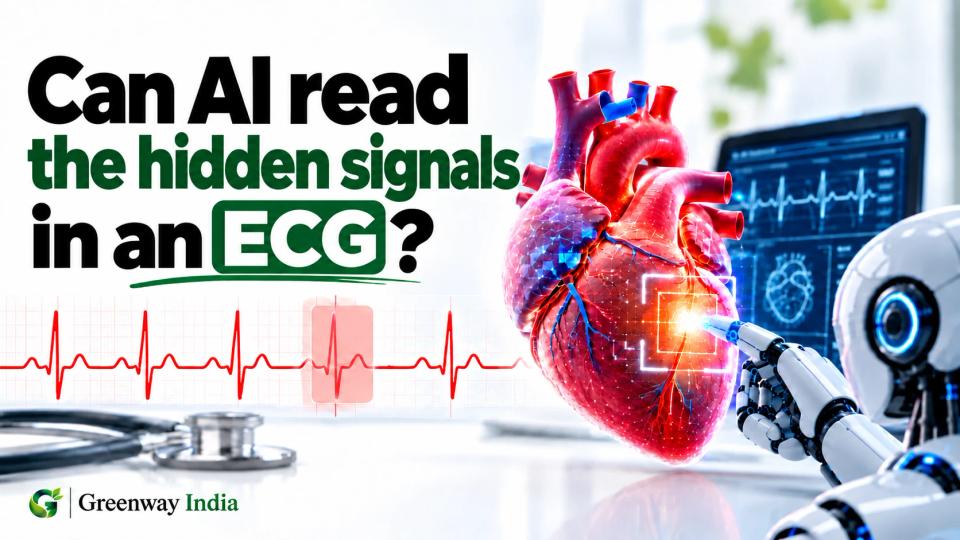
Could an ordinary ECG reveal signs of reduced heart-pumping function with the help of artificial intelligence? What a Mayo Clinic trial involving 22,641 adults actually found—and what it did not.
Imagine someone having an ECG during a routine medical visit. They have never been diagnosed with heart failure. Nothing about that short test immediately suggests an urgent cardiac emergency.
But what if the electrical signals recorded by the ECG contain subtle patterns associated with a heart that is not pumping as effectively as it should?
Could an AI system help a clinician identify that possibility and recommend a closer look?
Researchers at Mayo Clinic investigated this question in a major randomized clinical trial called EAGLE. Its findings were promising, but the distinction between an early warning and a medical diagnosis matters.
What does an ECG actually measure?
An electrocardiogram (ECG or EKG) is a quick, painless test that records the heart's electrical activity. Clinicians use it to assess heart rate, rhythm, and patterns of electrical conduction.
An ECG is different from an echocardiogram. An echocardiogram uses ultrasound to create moving pictures of the heart and assess how effectively it pumps blood.
The EAGLE researchers wanted to know whether an AI algorithm examining the ECG signal could flag people more likely to have reduced pumping function—before the problem had been formally diagnosed.
Understanding ejection fraction
Left ventricular ejection fraction (LVEF) measures the percentage of blood pushed out of the heart's left ventricle with each contraction.
The American Heart Association describes 55–70% as a normal range. A reduced value can indicate a problem with pumping function, although ejection fraction alone does not establish every type of heart disease. Some people have heart failure despite a preserved ejection fraction.
The EAGLE trial specifically assessed new diagnoses of an EF of 50% or lower. It did not test an AI system that could forecast when a heart attack would happen.
The EAGLE trial: 22,641 adults
Published in Nature Medicine in 2021, EAGLE was a pragmatic, cluster-randomized clinical trial involving 120 primary-care teams across 45 clinics or hospitals.
A total of 22,641 adults, without previously documented heart failure, underwent ECGs as part of routine care.
Clinicians in the intervention group could see the AI-generated ECG screening result. Clinicians in the control group provided usual care without access to those AI results.
The primary question was straightforward: How many patients would receive a new diagnosis of low EF (≤50%) within 90 days of their ECG?
What changed when clinicians had AI results?
The rate of newly diagnosed low EF was 1.6% in the usual-care group and 2.1% in the AI-supported group.
That is an absolute difference of 0.5 percentage points, or a 32% relative increase in new diagnoses. Expressed another way, the intervention yielded approximately five additional diagnoses per 1,000 patients compared with usual care.
This distinction is essential: A 32% relative increase in diagnoses does not mean the AI was 32% more accurate. Nor does it establish that deaths or future hospital admissions were reduced.
The finding instead suggests that AI-assisted ECG interpretation helped clinicians identify some patients whose reduced pumping function might otherwise have remained unrecognized.
What happened after a positive AI result?
Approximately 6% of participants received an AI-ECG result suggesting a higher likelihood of low EF.
Among patients with a positive AI result, 38.1% in usual care underwent echocardiography, compared with 49.6% when clinicians had access to the AI information.
Across all trial participants, overall echocardiogram use was similar—18.2% in usual care versus 19.2% in the AI-supported group, a difference that was not statistically significant.
In other words, AI did not independently confirm a heart condition. It supplied an additional signal that clinicians could use when deciding who needed further assessment.
Can AI predict a heart attack?
Not on the basis of this trial. A heart attack, reduced ejection fraction, and an abnormal heart rhythm are different clinical issues.
A heart attack generally involves reduced or blocked blood flow to heart muscle. Ejection fraction measures the proportion of blood pumped out of the left ventricle during each contraction.
These issues can be related, but they are not interchangeable. The EAGLE algorithm was evaluated as a screening aid for possible low ejection fraction—not as a tool that predicts an individual's next heart attack or its timing.
Can an AI-ECG result be wrong?
Yes. Like other screening methods, AI systems can miss real problems or flag people who do not ultimately have the condition.
Performance may vary with the population being examined, the ECG equipment and signal quality, the model's training data, and how the tool is integrated into clinical care. Results from one health system cannot automatically be generalized to every country or hospital.
Crucially, EAGLE demonstrated an improvement in case detection, not proof that using the AI system reduces long-term heart-failure hospitalizations or mortality. Those questions require separate clinical evidence.
Will AI replace cardiologists?
The EAGLE study does not support that conclusion.
The AI system provided information to clinical teams. Physicians still considered the patient's symptoms, history, examination, and other tests. An echocardiogram could then be used to assess pumping function directly.
The realistic value of AI in this setting is helping appropriate patients reach appropriate follow-up care—not replacing clinical judgment.
What should patients take away?
Never wait for an AI test if someone develops potentially serious symptoms such as persistent chest pain or pressure, sudden shortness of breath, cold sweats, or loss of consciousness. Seek emergency medical care immediately through local emergency services.
Whether an ECG, echocardiogram, or additional cardiac evaluation is appropriate depends on individual circumstances and should be discussed with a qualified clinician. Research findings should not be used to self-diagnose or change treatment.
The bigger picture
AI is finding new ways to extract clinically useful information from familiar tests such as the ECG.
EAGLE offers real-world randomized evidence that AI-supported ECG interpretation can increase the recognition of reduced heart-pumping function in some patients.
That is an important step—not because AI can see everyone's medical future, but because an additional, responsibly validated signal may help clinicians identify otherwise missed problems and arrange timely follow-up.
The true measure of progress in medical AI will remain patient safety, high-quality evidence, and better care.
Research references
- Yao X, et al. Artificial intelligence–enabled electrocardiograms for identification of patients with low ejection fraction: a pragmatic, randomized clinical trial. Nature Medicine (2021): https://doi.org/10.1038/s41591-021-01335-4
- Mayo Clinic — EAGLE trial overview (2021): https://newsnetwork.mayoclinic.org/discussion/trial-demonstrates-early-ai-guided-detection-of-heart-disease-in-routine-practice/
- NIH/NHLBI — Heart Tests: https://www.nhlbi.nih.gov/health/heart-tests
- American Heart Association — Ejection Fraction: https://www.heart.org/en/health-topics/heart-failure/diagnosing-heart-failure/ejection-fraction-heart-failure-measurement
- American Heart Association — Heart Attack Warning Signs: https://www.heart.org/en/health-topics/heart-attack/warning-signs-of-a-heart-attack
Greenway India — Editorial Note
Greenway India is committed to bringing readers timely, evidence-based information about medical innovations, scientific research, and technological advances taking place around the world.
Medical Disclaimer: This article is intended for educational and informational purposes only. It does not constitute medical advice, diagnosis, or treatment. Readers should consult qualified healthcare professionals regarding screening decisions, medical concerns, or treatment options.