

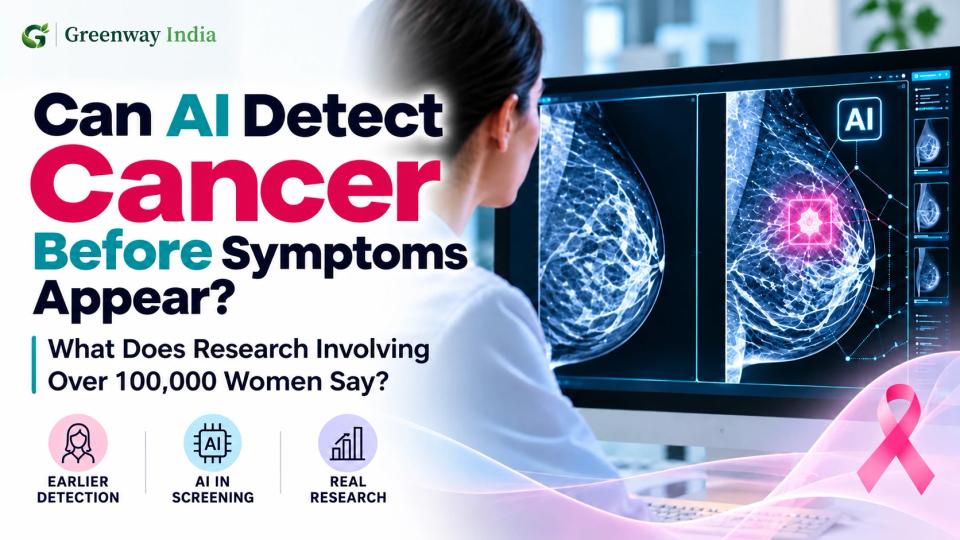
What a major Swedish study involving more than 100,000 women reveals about AI-assisted mammography, earlier cancer detection, and the limits of artificial intelligence in healthcare.
Imagine going for a routine breast cancer screening with no noticeable symptoms.
A mammogram captures detailed images of breast tissue. Radiologists carefully examine those images, looking for changes that might indicate cancer.
But what happens when artificial intelligence examines the same images alongside medical professionals?
Could AI help identify suspicious changes that might otherwise be difficult to detect?
This question is no longer confined to futuristic medical predictions. Researchers in Sweden have investigated it through one of the largest randomized studies of AI-assisted breast cancer screening.
The findings offer encouraging evidence—but they also reveal why understanding AI's limitations matters just as much as celebrating its capabilities.
Why early detection matters
Breast cancer does not always produce noticeable symptoms in its early stages.
Mammography screening aims to identify suspicious changes before symptoms develop, potentially allowing earlier investigation and treatment.
However, screening is not perfect. Some cancers may go undetected, while some findings that appear suspicious turn out not to be cancer.
Researchers are investigating whether AI can help radiologists improve this balance.
Inside the Swedish MASAI trial
The study, known as MASAI—Mammography Screening with Artificial Intelligence—was conducted within Sweden's breast cancer screening program.
Between April 2021 and December 2022, researchers randomly assigned 105,934 women to two groups. Results from 105,915 participants were included in the 2025 analysis.
One group underwent AI-supported mammography screening, while the other received standard screening involving two radiologists.
In the AI-supported group, the technology helped determine whether examinations required one or two radiologist readings and highlighted suspicious findings for review.
AI did not independently diagnose cancer or prescribe treatment.
The 2025 analysis was published in The Lancet Digital Health. Read the original study (2025)
What did researchers discover?
Cancer detection in the 2025 MASAI analysis:
Participants: AI-supported screening — 53,043; Standard screening — 52,872.
Cancers detected during screening: AI-supported screening — 338; Standard screening — 262.
Cancers detected per 1,000 participants: AI-supported screening — 6.4; Standard screening — 5.0.
The AI-supported approach produced a 29% relative increase in the cancer detection rate compared with standard screening.
The additional invasive cancers detected were predominantly small cancers without evidence of spread to nearby lymph nodes.
Importantly, the study did not find a statistically significant increase in false-positive rates. Source: The Lancet Digital Health (2025)
That is encouraging—but it does not mean AI is 29% more accurate overall, or that it prevents 29% more cancer deaths.
Those are different outcomes requiring separate evidence.
Could AI also reduce radiologists' workload?
The study reported another significant finding.
In the standard-screening group, radiologists performed 109,692 screen readings. The AI-supported group required 61,248 readings.
That represented a 44.2% reduction in the number of mammography screen readings.
This could have important implications for screening programs managing large numbers of examinations.
However, the reduction relates specifically to image-reading workload, not the total workload of hospitals or healthcare professionals. Source: MASAI study (2025)
The 2026 findings: What happens after screening?
Detecting more cancers during screening is only part of the story.
Researchers must also investigate interval cancers—cancers diagnosed between scheduled screening rounds after they were not detected during screening.
A follow-up MASAI analysis, published in The Lancet in January 2026, examined this important outcome.
Interval cancers per 1,000 participants: AI-supported screening — 1.55; Standard screening — 1.76.
Screening sensitivity: AI-supported screening — 80.5%; Standard screening — 73.8%.
Screening specificity: AI-supported screening — 98.5%; Standard screening — 98.5%.
Sensitivity measures how successfully a screening process identifies cancers among those with cancer, while specificity reflects how accurately it classifies participants without cancer.
AI-supported screening achieved significantly higher sensitivity while maintaining the same specificity.
Researchers also established that its interval cancer rate was not inferior to standard screening. This does not mean that a statistically significant reduction in interval cancer incidence was established. Source: The Lancet (2026)
Does AI predict cancer before it develops?
Not necessarily—and this distinction is crucial.
Early detection means identifying cancer that already exists, potentially before symptoms become noticeable.
Risk prediction means estimating the likelihood that someone may develop cancer in the future.
The MASAI trial primarily investigated screening performance and detection of existing breast cancer.
It did not establish that AI can accurately predict exactly who will develop breast cancer years before it appears.
Confusing these two concepts can create unrealistic expectations about medical technology.
Can AI make mistakes?
Yes.
AI-supported screening can still miss cancers, and suspicious findings can still turn out to be harmless.
Additional imaging or a biopsy may be necessary before a diagnosis can be confirmed.
Performance can also vary depending on the AI system, screening population, image quality, and clinical setting.
Results from a Swedish screening program cannot automatically be assumed to apply identically to every healthcare system worldwide.
That is why rigorous clinical validation, professional oversight, and ongoing safety monitoring remain essential.
Will AI replace radiologists?
The MASAI study does not demonstrate that radiologists are no longer needed.
Instead, it illustrates how AI can assist medical professionals with particular screening tasks.
Radiologists remain important for interpreting findings, evaluating clinical context, recommending further examinations, and contributing to diagnostic decisions.
AI is best understood here as a specialized clinical support technology—not a universal replacement for medical expertise.
What does this mean for the future of healthcare?
The MASAI findings suggest that appropriately evaluated AI systems can improve aspects of breast cancer screening.
The potential benefits include identifying more cancers during screening and reducing the number of images requiring radiologist readings.
However, long-term clinical outcomes, implementation costs, effectiveness across different populations, and patient safety remain essential considerations.
The most meaningful measure of progress is not simply how sophisticated an AI system becomes.
It is whether the technology helps people receive appropriate medical care at the right time.
The bigger picture
Artificial intelligence is changing how researchers and clinicians approach medical imaging.
In breast cancer screening, the MASAI trial offers substantial evidence that AI-assisted workflows can improve detection performance under carefully evaluated conditions.
But AI is neither infallible nor capable of replacing every aspect of clinical judgment.
The future of medical AI should be measured by better patient outcomes, reliable evidence, and responsible clinical use—not by technological promises alone.
Research references
1. The Lancet Oncology (2023) — MASAI initial safety analysis
2. The Lancet Digital Health (2025) — Screening performance and cancer detection
3. The Lancet (2026) — Interval cancer, sensitivity and specificity
Greenway India — Editorial Note
Greenway India is committed to bringing readers timely, evidence-based information about medical innovations, scientific research, and technological advances taking place around the world.
Medical Disclaimer: This article is intended for educational and informational purposes only. It does not constitute medical advice, diagnosis, or treatment. Readers should consult qualified healthcare professionals regarding screening decisions, medical concerns, or treatment options.