

When rain arrives, we notice the sound before we notice much else. Then come wet soil, puddles and water soaking into the ground. But what happens around a seed beneath the water?
MIT researchers investigated whether vibrations produced by raindrops could affect germination. “Hearing” is a useful question for a headline, provided we keep its meaning clear: responding to physical vibrations is different from listening as a person does.
An experiment with droplets, not a rain soundtrack
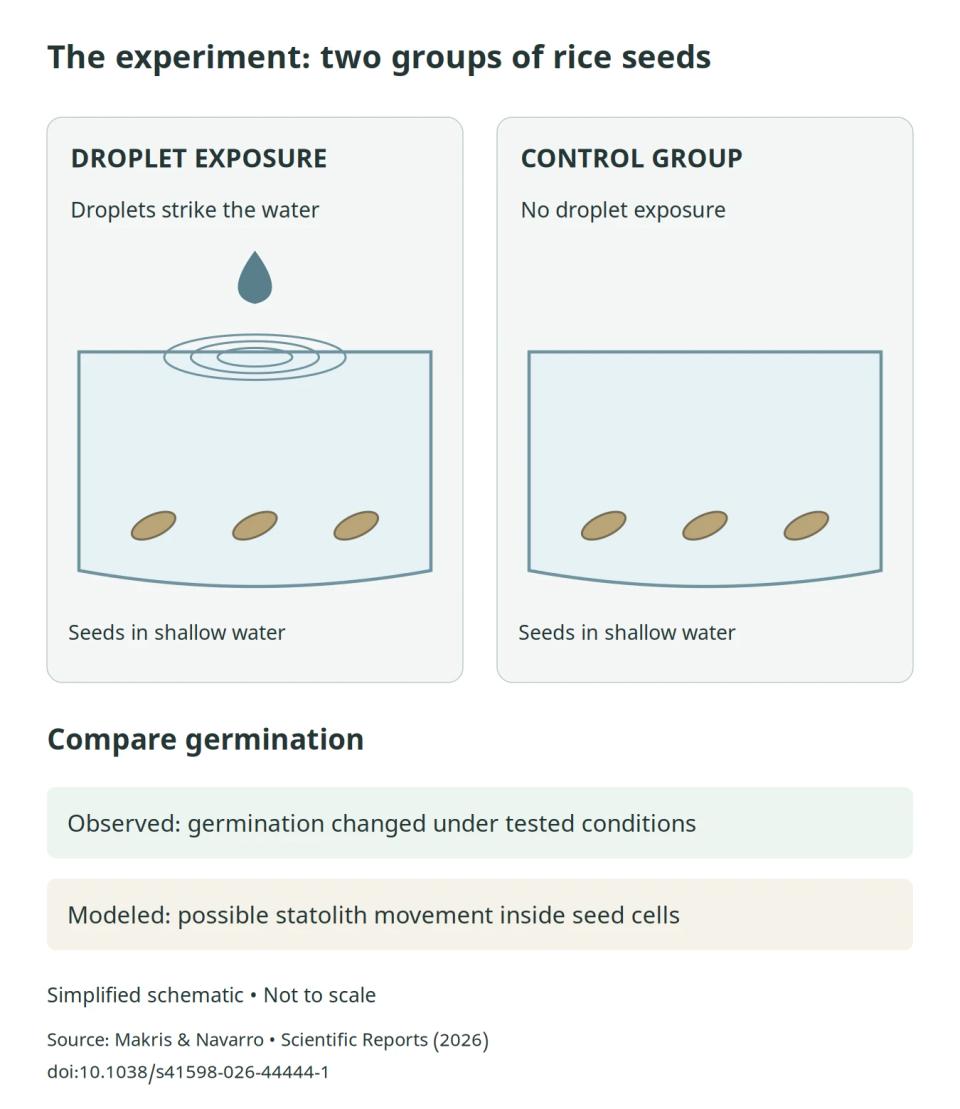
The researchers compared rice seeds submerged in shallow water and exposed to droplet vibrations with controls without that exposure. They used actual water droplets rather than a recording played through a speaker. MIT’s account of the experiment
Across repeated six-day tests, approximately 7,860 seeds were examined. Nicholas C. Makris and Cadine Navarro published the study in Scientific Reports on 22 April 2026. Original paper
What changed?
Under the conditions showing the strongest response, mean germination-rate increases over controls ranged from 24% to 37% across measurements on days three to six. The reported standard deviations at those endpoints were 6.4% and 6.2%, respectively. These are relative increases over controls, not percentage-point differences. Weaker exposures produced smaller responses; the most distant, very weakly exposed group showed no significant effect. Paper: germination results and Figure 3
That is a germination result, not evidence of a 37% increase in harvest yield. Those are different outcomes, and the distinction matters before anyone turns an intriguing finding into farming advice.
A possible mechanism inside the seed
The proposed explanation involves statoliths, small particles associated with plants’ gravity-sensing system. Calculations suggest droplet vibrations could move these particles and stimulate a growth response. This mechanism was modeled; the study did not directly film and establish the entire cellular sequence. Original study
What the evidence does—and does not—cover
| Examined in this study | Not established by this study |
|---|---|
| Germination responses in submerged rice seeds | The same response in every seed species |
| Droplet vibrations under controlled conditions | Consistent yield gains in ordinary fields |
| A calculated cellular explanation | Direct proof of the complete mechanism |
Source: Original study. The right column identifies limits of the evidence.
Should growers change anything?
This study does not justify playing rain recordings to crops or changing cultivation practices. Other seeds, soils and field conditions need testing before practical recommendations follow.
Its immediate value is a different way of looking at something familiar. We usually think of rain as a supply of water. Could a droplet also deliver a physical cue to a seed? The experiment gives researchers a way to investigate that question without assuming that a seed experiences sound as we do.
Sources
- Makris, N. C. & Navarro, C. (2026). Seeds accelerate germination at beneficial planting depths by sensing the sound of rain. Scientific Reports, 16, 11248. DOI
- MIT News, 22 April 2026. Plants can sense the sound of rain, a new study finds. Institutional explanation from the researchers’ university, not independent replication.