

Some decisions are difficult because we lack information. Others remain difficult even when we understand the facts: every available choice seems to put something we value at risk.
Speaking up about a problem at work may threaten our position. Remaining silent may trouble our conscience. Supporting one family member may hurt another. At such moments, reassurance can help, but it may not explain what we ought to do.
These are contemporary examples. Arjuna’s situation in the Bhagavad Gita is far more severe. He faces a war involving death, kinship and competing claims of duty. An ordinary workplace disagreement is not equivalent to that crisis. Still, we can notice how uncertainty about the right course of action becomes the starting point for a sustained conversation.
For a new reader, that is a useful place to begin.
First, where does the Gita belong?
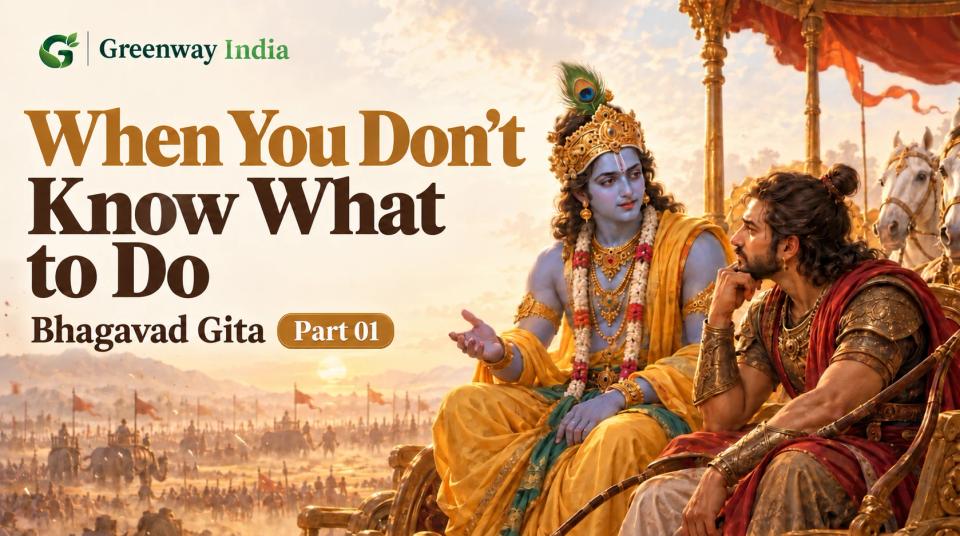
The Bhagavad Gita is an eighteen-chapter dialogue within the Bhishma Parva of the Mahabharata. Its setting is the battlefield of Kurukshetra, just before the fighting begins. Arjuna is on his chariot, with Krishna as his charioteer.
The Gita is a sacred text within Hindu traditions. Krishna’s role extends beyond that of a friend offering practical advice: his divine authority is integral to the teaching. The conversation addresses action, knowledge of the self, devotion, meditation and liberation.
Reading isolated sayings can therefore leave an important question unanswered: what difficulty was this statement addressing in the first place?
Is Arjuna simply afraid?
Arjuna is an accomplished warrior. Yet the sight of his own people facing him in battle unsettles him profoundly. In Chapter 1, verses 28 and 29, he describes failing limbs, a dry mouth, trembling and his bow Gandiva slipping from his hand.
We need not attach a modern medical diagnosis to this description. Within the narrative, it makes his distress unmistakable.
In Chapter 1, verse 31, Arjuna says he sees no good in killing his relatives and has no desire for the victory, kingdom or pleasures that might follow. His concern reaches beyond whether he can win. He questions the value of what winning would require.
This matters when we first approach the Gita. A task that appears straightforward from outside may look very different to the person who must perform it. Affection, responsibility, harm and moral judgment can pull in different directions.
The turning point: admitting uncertainty
In Chapter 2, verse 7, Arjuna explicitly acknowledges his confusion about dharma. He asks Krishna to tell him what would truly be good for him, declares himself a disciple and requests instruction.
A short passage from that verse reads:
pṛcchāmi tvāṁ dharma-sammūḍha-cetāḥ |
yac chreyaḥ syān niścitaṁ brūhi tan me |
— Bhagavad Gita 2.7, excerpt
In our own words, the sense of this passage is: I am confused about dharma; tell me clearly what would truly be good for me.
The speaker matters. Arjuna is acknowledging his own uncertainty. This is not a line to use against someone else to dismiss their judgment. Within the dialogue, it marks a significant turn towards a teacher–disciple relationship.
A modest contemporary reflection follows from this. Recognising that we need help with a decision does not erase our abilities. We may be capable in many areas and still need guidance about a particular responsibility or conflict.
Does the Gita leave everything open to questioning?
Arjuna asks questions, and Krishna teaches. Philosophical inquiry forms part of their exchange, alongside spiritual authority, devotion and surrender.
In Chapter 18, verse 63, Krishna asks Arjuna to reflect fully on what has been taught and then act according to his choice. The invitation to reflection is significant. But the conversation does not end at that verse. Further teaching on devotion and surrender follows, including the well-known verse 18.66.
In verse 18.73, Arjuna says that his delusion and doubt have been dispelled and that he will act according to Krishna’s instruction. He also attributes his restored understanding to Krishna’s grace.
We should therefore be careful about making a single sentence stand for the entire text. The Gita cannot be reduced to permission to do whatever we already prefer. Its questions also deserve attention. Reflection, instruction, devotion and action must be read within their relationship to one another.
Why do interpretations differ?
Major teachers, including Shankara, Ramanuja and Madhva, have interpreted the Gita from distinct philosophical positions. Their accounts of the self, the divine, knowledge, devotion and liberation are not identical.
An explanation from one commentary should therefore be identified as that commentary’s perspective when the distinction matters. It should not silently become the only possible meaning of the text.
In this series, we will begin with the relevant verse and the surrounding conversation. Where an interpretive difference materially affects the explanation, we will identify it. Contemporary examples will remain our editorial illustrations, rather than statements attributed to Krishna or events claimed to occur in the scripture.
A practical way to begin reading
There is no need to master every verse at the outset. Start with Chapter 1 and notice the reasons Arjuna gives for his distress. Then read Chapter 2, verse 7 with the surrounding exchange.
Three questions can guide the reading:
- Who is speaking here?
- Which question or argument is being addressed?
- Is this point in the original text, a commentator’s explanation or a contemporary application?
It is natural to look for a line that speaks immediately to our own circumstances. Understanding what that line is doing in the text gives us a firmer basis for considering its relevance.
Suppose we face a difficult decision at work. We might separately write down our family’s needs, our responsibilities and the likely effects on others. That exercise is a contemporary suggestion offered by this article, not a direct instruction from the Gita. It may not make the decision easy, but it can help reveal what our judgment rests on.
Where this series goes next
We will take one question at a time. What does working without attachment to results mean? Does equanimity require suppressing emotion? How can a restless mind engage in practice? Each article will return to the relevant passages and their setting.
We do not need to arrive at the Gita with all the answers. We can begin with the honesty visible in Arjuna’s request: an acknowledgment of uncertainty and a willingness to learn.
That is where our reading begins.
Next in the series: What Does It Mean to Work Without Attachment to Results?
References
- Bhagavad Gita 1.28 — Sanskrit and translations, IIT Kanpur Gita Supersite
- Bhagavad Gita 1.29 — Sanskrit text, BBT VedaBase
- Bhagavad Gita 1.31 — Sanskrit text, BBT VedaBase
- Bhagavad Gita 2.7 — Sanskrit and translations, IIT Kanpur Gita Supersite
- Bhagavad Gita 18.63 — Sanskrit text, BBT VedaBase
- Bhagavad Gita 18.66 — Sanskrit text, BBT VedaBase
- Bhagavad Gita 18.73 — Sanskrit text, BBT VedaBase
- Nicholas Sutton, Bhagavad-gita: The Oxford Centre for Hindu Studies Guide, “Getting started,” printed pp. 9–11 and 14–15 (PDF pp. 16–18 and 21–22): narrative context and an introduction to major commentators.
Passages are explained in original editorial language. VedaBase’s commentary belongs to the Gaudiya Vaishnava tradition and has not been treated as an interpretation shared by all schools. The Sanskrit excerpt is from Gita 2.7; its English explanation is our own.